
|
 Sometimes
it's nice just to get back to the basics. With all the amp simulators
coming down the pike these days-modeling just about any type of amp you
could imagine-it was a treat to get a chance to review the Legacy VL212,
a traditional tube amp that could stand on its own. Don't get me wrong,
I think technology is doing an amazing job, making it possible to carry
a dozen amps in your gig bag. But they have to model those sounds off
of something, and there's nothing like the real thing baby, if you know
what I mean. Nothing to program, no wordy manual to interpret, just your
basic volume and tone knobs-set 'em and let her rip. If you've read any
of my articles over the past several years, you know I've reviewed quite
a few amp simulators/processors and they've saved my butt more than once
when I've been stuck using bad amplifiers with no tone on cruise ship
gigs. They also come in handy for direct recording which saves a great
deal of studio time setup. But the fact of the matter remains that I am
basically a traditionalist: my main rig is a tube amp-Mesa Boogie 50 Caliber.
It was great to review a tube amp that I could just take to the gig, without
any manuals, set my tones and play.
When
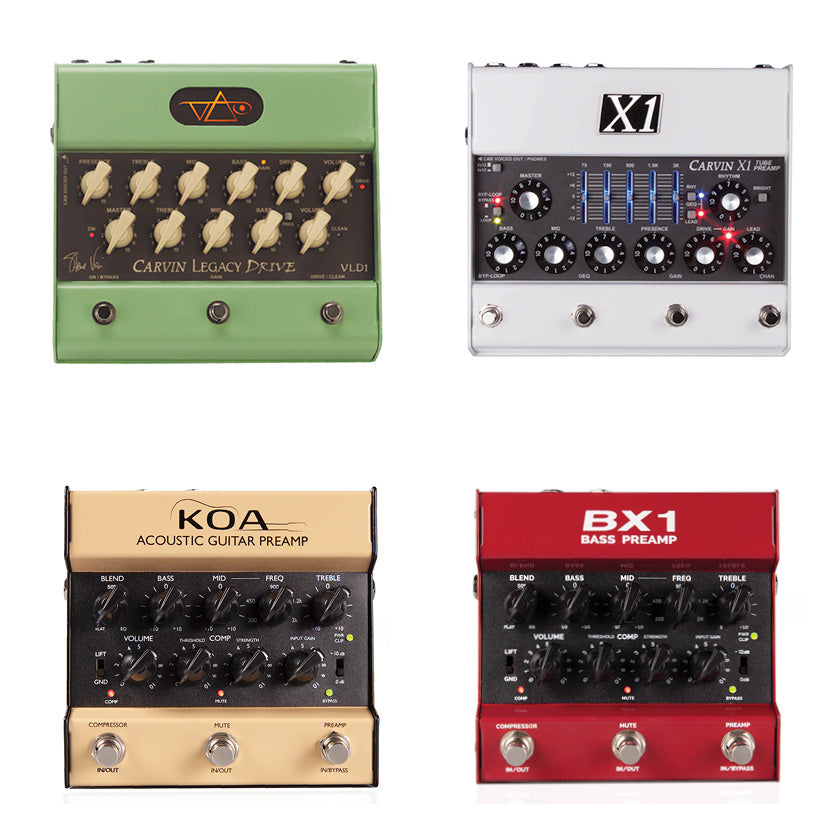
it comes to the tube amps available today, the Steve Vai signature Legacy
series is in a class all its own. Even at first glance its appearance
is an eye-catcher. Off-white, chicken-head volume and tone knobs and the
metal see-through grill covering the speakers give the look of class and
durability. Priced reasonably at $949.95, the Carvin operating manual
has Steve Val quoted as saying, "It had to be something affordable for
most musicians and not for just a few privileged ones." With a world-class
guitarist like Steve Val playing with tube and circuitry variations, and
also testing dozens of enclosures loaded with various vintage and prototype
speakers, you expect tone. Let's see what he came up with.
The
Meat and Potatoes
Even
though the VL212 is a straight-ahead, in-your-face tube amp, there are
several features about this amp that give it a vintage sound with a modern
twist. The clean and overdrive channels have independent volume, bass,
mid, treble and presence controls unlike many other multi-channel tube
amps that have separate volume and gain controls but often share EQ. The
clean channel's bright switch boosts only the guitar's highest harmonics,
which are in the 10 kHz range instead of the 3 kHz range of a normal bright
switch. This will add an acoustic shimmer to your guitar for sweet rhythm
playing, while the presence knob control on the lead channel adjusts the
edge of your tone. With a wide range, you can get super smooth tones or
crank it up and add bite to your leads. The greater range of the passive
bass, mid and treble controls is due to the high-impedance 1 meg sealed
pots (most guitar amps use 250k pots).
The
Legacy's incredible highs stem from the very high treble frequency setting
of 11 kHz; while the bass is set at 80 Hz and mid at 650 Hz.
The
reverb system is reminiscent of '60s tube amps with a "pre-filter" eliminating
the spring "boing" heard in other combo amp reverb units. The FS22 footswitch
switches only the reverb send, leaving the tall of the reverb to decay
naturally-the way it is done in the studio. Even my Boogie-with a modified
spring reverb unit-doesn't do this. For example, you're playing a lead
or single note line and the reverb can make your last note hold over,
you can use the footswitch and turn it off, leave your last note hanging
and be playing another part and almost sound as if there are two guitar
players on stage.
The
Legacy uses EL34 power tubes, which have a smooth distortion tone when
overdriven. The tubes react even to the most subtle changes: play soft
and they remain clean, play harder and they become more distorted. But
if you want to customize your Legacy to your own personal tube taste,
there is a bias switch for 5881 or 6L6GCs, making power tube changes a
breeze.
A
snazzy feature-something I was fond of because I play different size venues-was
the 100/50-watt switch. Switch to 100 watts and you get four power tubes
(when you need that extra oomph) or switch to 50 watts using two power
tubes, and you can get your amp to clip at lower levels for smaller rooms.
Some
of the other features are: a cabinet-voiced line out, 2 1/4" speaker jacks
also with a speaker impedance switch for four, eight or 16 ohms to match
your speaker system, and the Vai Hidden Feature, allowing you to use the
lead channel with a generous amount of drive, then back off the volume
on your guitar causing the channel to become cleaned up at a lower volume.
This feature is handy for playing both lead and rhythm without switching
channels.
On
the Gig
To
begin with, setup was a snap. The room I was playing didn't really allow
for a sound check as it was a three-nighter in a hotel lounge adjacent
to the dining room which always had customers present, so under these
circumstances, using new equipment can be a little scary. Even after you
program your sounds, you always need to EQ some for a live performance.
But with the VL212, this was no problem. I picked out some basic settings
at home for my lead and rhythm channels and through the first set I simply
turned around and tweaked the knobs just like the good old days.
At
the end of the first night, our keyboard player came over to ask if I
was reviewing something new saying "your leads are cutting through. "
Which prompted the rest of the band to start commenting on the tone of
my guitar that evening and how much they liked the sound of this amp.
I was in hog heaven because my solo tone was hot and rhythm tones were
cool and crisp. With the wide frequency range of the tone settings, I
was able to EQ my tone to cut through the band without having to increase
my volume. And as any guitar player knows, we always get hit with that
volume thing.
In
the end, the Legacy VL212 proved to be a solidly built, greatsounding
amp in the tradition of the classics, but with some modern features that
really make it stand out.
|